
The recent AWS re:Invent conference has marked a major turning point — not just in how we think about artificial intelligence, but in how we build, deploy, and scale intelligent systems. In this article, we unpack the key announcements, core innovations, and the profound implications for developers, enterprises, and society at large.
Strands Agents SDK — Build Agents Without Boilerplate
AWS introduced Strands, a streamlined, model-driven SDK that dramatically reduces the overhead of building agents:
- No need for extensive orchestration code — Strands handles reasoning, planning, and tool selection.
- Supports multiple agents, works in Python and TypeScript, and operates even at the edge (robots, IoT).
- Enables innovation for developers, researchers, or hobbyists alike.
Strands effectively lowers the barrier to building real agents — not simple chatbots but functional autonomous workflows.

Amazon Bedrock AgentCore — Production-Ready Agent Infrastructure
One of the marquee reveals: Amazon Bedrock AgentCore — a modular, enterprise-grade platform for deploying agents at scale.
Key capabilities include:
- Scalable infrastructure for thousands of long-running sessions.
- Built-in identity & access management for secure operations.
- Episodic memory: agents that learn from past interactions and adapt.
- Policy controls and testing tools (like simulation environments) to ensure safe deployment.
With AgentCore, enterprises can finally shift from proof-of-concept agents to mission-critical deployments.
Episodic Memory — Agents That Remember and Learn
A notable upgrade: agents can now retain episodic memory — storing past interactions as discrete “episodes.”
This allows agents to adapt:
- Adjust responses based on user behavior or preferences (e.g., solo vs. family travel).
- Maintain context across sessions for more personalized experiences.
Episodic memory is a big step toward agents behaving like real teammates — adaptive, contextual, and long-term aware.
Reinforcement Fine-Tuning (RFT) & Model Customization at Scale
To ensure agents perform reliably, AWS unveiled Reinforcement Fine-Tuning (RFT) on Amazon Bedrock.
- Enables RL-based training workflows with minimal overhead.
- Delivers on average +66% gains in model accuracy.
- Combined with model distillation and fine-tuning, enables production-ready, efficient, domain-specific models.
Additionally, AWS introduced SageMaker HyperPod and checkpointless training, greatly reducing training costs, boosting reliability, and enabling rapid customization.
Amazon Nova Forge & Nova Act — Frontier Models and Reliable UI Automation
AWS didn’t stop at tooling. They launched:
- Amazon Nova Forge: Lets organizations build custom “frontier” models tailored with domain-specific data — avoiding the heavy lifting of full model training. Ideal for specialized industries (finance, healthcare, aerospace).
- Amazon Nova Act: A fully integrated stack to automate UI workflows using reinforcement-learned agents — capable of interacting with web interfaces, forms, dashboards with ~90% reliability.
These offerings bridge the gap between experimentation and real-world enterprise usage.
AWS’s Built-in “Teammate” Agents — Kiro, Security, DevOps & More
AWS showcased its vision of agents as constant collaborators — not just for developers but for entire organizations:
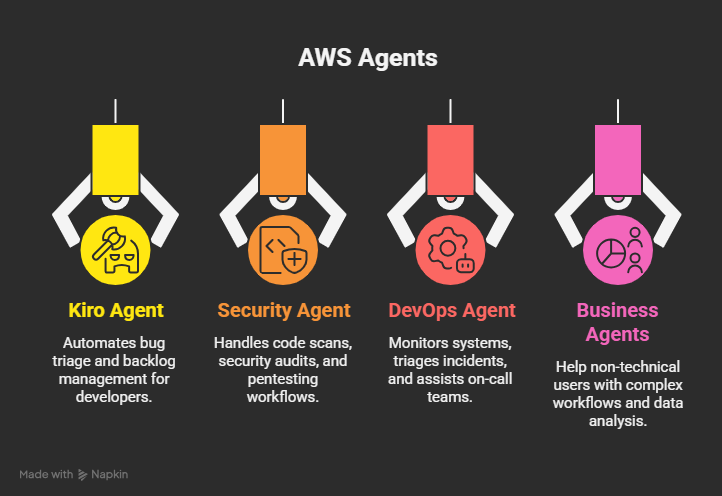
- Kiro Agent — automates bug triage and backlog management.
- AWS Security Agent — handles code scans, security audits, pentesting workflows.
- AWS DevOps Agent — monitors systems, triages incidents, assists on-call teams.
- Business Agents & Analytics Agents (e.g., via QuickSight) — help non-technical users with complex workflows and data analysis.
This signals a future where agents become standard “team members,” amplifying human capabilities across roles.
Real-World Impact — From Space Exploration to Customer Service
The conference featured compelling examples:
- Space & Aerospace (e.g., Blue Origin ): Over 2,700 agents in production, automating rocket simulations, design optimization, resource planning — even lunar regolith processing.
- Customer Service & Fraud Detection (via Amazon Connect & Nova 2 Sonic): Agents handling identity verification, fraud prevention, real-time customer support — integrating voice, text, and security workflows.
These demonstrate that agentic AI is not a futuristic concept—it’s being used today across industries.
Broader Implications: Why This Matters
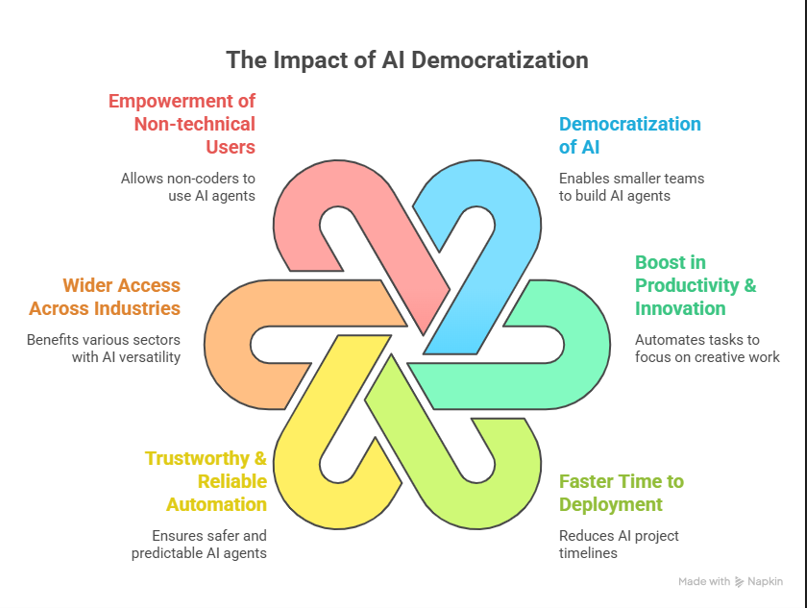
- Democratization of AI: With Strands, Bedrock AgentCore, RFT, and Nova Forge, even smaller teams or startups can build powerful, domain-specific AI agents without huge budgets or deep infrastructure knowledge.
- Boost in Productivity & Innovation: By automating repetitive tasks (DevOps, security reviews, UI workflows, customer service), organizations can focus on creative, high-value work.
- Faster Time to Deployment: Tools and managed infrastructure reduce friction from months-long AI projects to weeks or days.
- Trustworthy & Reliable Automation: Through formal reasoning, policies, RL training, and robust infra — agents become safer and predictable, making them suitable for enterprise adoption.
- Wider Access Across Industries: From healthcare, finance, and manufacturing to space research and environmental projects — the versatility of agents means nearly any domain can benefit.
- Empowerment of Non-technical Users: Business analysts, customer service teams, managers can now use AI agents without writing code — bridging the AI gap across skill levels.
Final Thoughts: A New Era of Collaboration — Human + Agent
AWS re:Invent 2025 doesn’t just mark incremental upgrades to cloud services — it signals a shift: from passive AI tools to active AI collaborators. By building the full-stack ecosystem — SDKs, orchestration, production deployments, model customization, policy & trust frameworks — AWS is enabling a future where every organization, big or small, can wield the power of agentic AI.
In that future, innovation, automation, and scalability are not just for tech giants. They’re available to anyone with a problem to solve. And that may well be the biggest announcement of all.
Leave a Reply